
About Oman
Discover a land of striking contrasts — sweeping deserts, emerald wadis, dramatic mountain ranges, and more than 1,700 km of pristine coastline. Situated on the southeastern edge of the Arabian Peninsula, Oman blends ancient culture with modern serenity.
Capital: Muscat
Population: 5.241 million (2024)
Area: 309,500 km²
Official Language: Arabic (English widely spoken)
Government: Monarchy under Sultan Haitham bin Tariq Al Said
Geography & Landscape
Oman’s landscape is remarkably diverse and plays a big role in shaping travel experiences across the country. Much of Oman consists of vast gravel plains, creating wide open desert scenery between towns and regions. Running through the north and east are the Hajar Mountains, stretching from Musandam down to Sharqiyah, offering dramatic viewpoints, cool highlands, and some of the country’s best hiking routes. The highest peak, Jebel Shams (3,009 m), is known as the “Grand Canyon of Arabia” and is a highlight for outdoor explorers.
Coastal travelers will find long, varied shorelines along both the Arabian Sea and the Gulf of Oman, where fishing villages, beaches, cliffs, and marine life shape the experience. Oman is divided into eleven governorates, each with its own geography, culture, and identity

Vast Gravel Plains
The Hajar Mountains Stretching From Musandam To Sharqiyah
Highest Peak: Jebel Shams – 3,009 M
Coastal Regions Along The Arabian Sea & Gulf Of Oman
Eleven Diverse Governorates, Each With Its Own Character
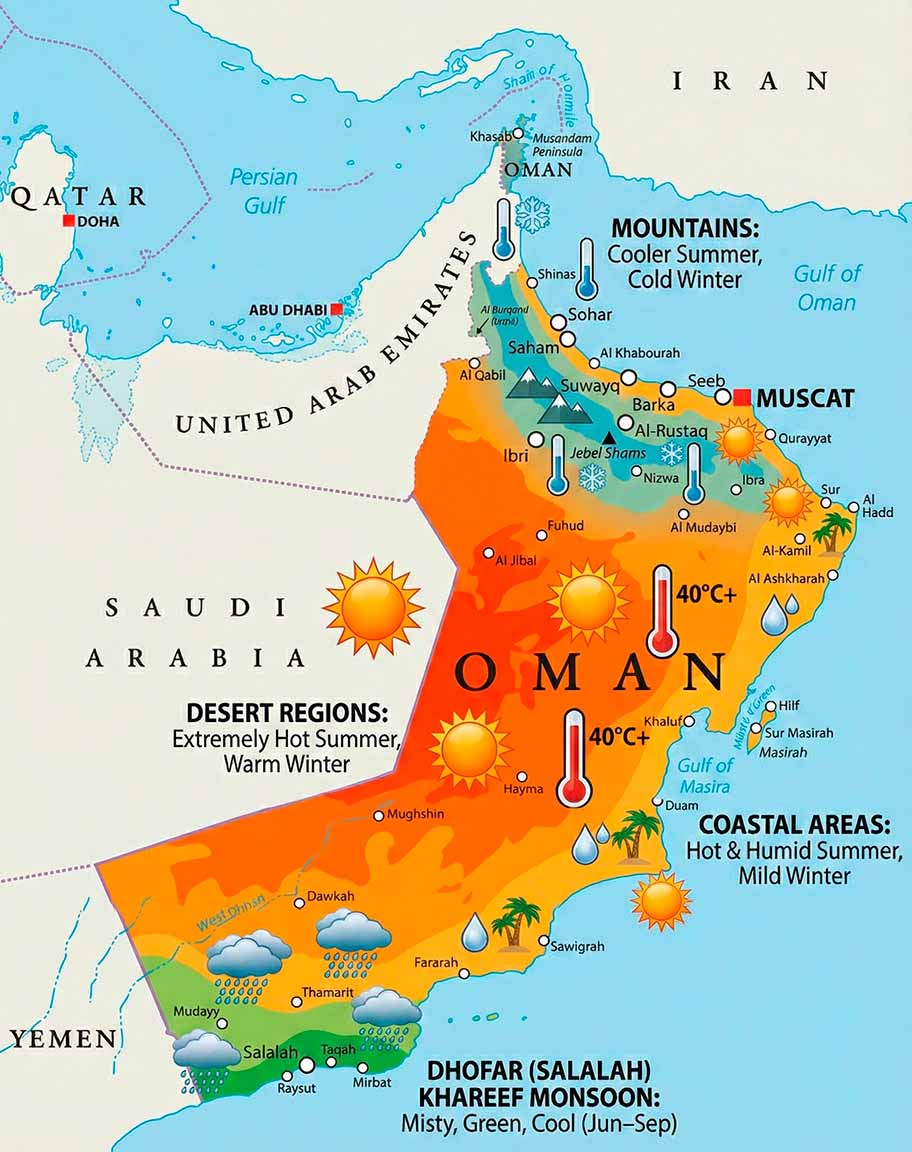
Climate in Oman
Oman’s weather varies across regions:
Desert Regions
Summer: Extremely hot (40°C+)
Winter: Warm days, cooler nights
Mountains
Summer: Cooler than lowlands
Winter: Cold with occasional frost
Coastal Areas (Muscat, Salalah)
Summer: Hot & humid
Winter: Mild and pleasant
Dhofar (Salalah)
Khareef Monsoon (Jun–Sep): Misty, green, cool
Practical Information for Travelers in Oman
MOBILE, INTERNET & BANKING
Oman has excellent mobile coverage and reliable internet services. Local SIM cards are available for purchase, and international banking facilities are widely accessible in major cities.
OPENING HOURS & ENTRANCE FEES
Most stores and attractions operate from 9 AM to 1 PM and 4 PM to 9 PM. Entrance fees vary, with many cultural sites offering discounted rates for students.
WEEKEND & RAMADAN OBSERVANCES
The weekend in Oman is Friday and Saturday, affecting business hours. During Ramadan, many restaurants have adjusted hours, and public displays of eating or drinking are discouraged.
Banking & Mobile
Mobile & Internet: 5G widely available; SIM cards sold at airports
Electricity: 220–250V, Type G plug
Banking: ATMs common; banks open Sun–Thu, 08:00–14:00
Currency: Omani Rial (OMR) 1 OMR = 2.60 USD
Local Culture
Understanding and embracing local customs is essential for a fulfilling visit. Dress modestly, be polite, and respect traditions to ensure a welcoming experience in this beautiful country.
Photography Guidelines
Always ask for permission before photographing individuals in Oman, particularly in cultural settings.
Respect local customs and understand restrictions on photographing military sites or sensitive areas
Opening Hours
Opening hours and entrance fees for some popular attractions: Hypermarkets are open every day from 08:00 to 23:00.
Souqs generally operate from around 09:00 to 13:00 and again from 16:00 to 20:30, though on Fridays they are only open in the afternoon and evening.
The forts welcome visitors from 09:00 to 16:00, with limited hours on Fridays, from 09:00 to 11:00.
The Sultan Qaboos Grand Mosque is open from 08:00 to 11:00, but it is closed on Fridays and during Islamic holidays.
Travel Tips
When preparing for a desert adventure, it’s important to bring a flashlight for desert camps and aim to arrive before sunset to fully experience the stunning landscape. It’s also best to avoid entering the desert after dark, as visibility can be challenging. For hotel stays, check-in is typically at 14:00, while check-out is by 12:00. When offered coffee or dates, it’s polite to accept them with your right hand. Bargaining is a common practice in the souqs, so don’t hesitate to negotiate prices. Additionally, be respectful of local customs by avoiding photographing or staring at women, as well as refraining from public displays of
affection, which are discouraged in the culture.
Female Solo Traveler
Oman is widely regarded as a safe and welcoming destination for solo female travelers, offering a relatively relaxed and friendly atmosphere. That said, it’s important to keep in mind the country’s conservative values and Islamic traditions, which shape many aspects of daily life. To respect local customs, dressing modestly is key—covering your shoulders and knees, and avoiding clothing that’s too tight or revealing. In more conservative areas, and particularly when visiting religious sites, wearing a headscarf is recommended. While public transportation is generally safe, opting for reputable taxi services is a wise choice. It’s also a good idea to pre-arrange transport, especially if you’re arriving after dark. If you plan to rent a car, take extra care on the roads and ensure you’re following local traffic laws to avoid any mishaps. With the right precautions, Oman can be an incredibly rewarding destination to explore.
Smoking, Alcohol, and Food Safety in Oman
SMOKING
Smoking is permitted only in designated areas. Visitors should respect local regulations and avoid smoking in public spaces to ensure a comfortable atmosphere for everyone.
ALCOHOL
Alcohol is available in licensed hotels and some venues but is prohibited in public places. Travelers must adhere to local laws and be mindful of cultural sensitivities.
DRINKING WATER
Drinking water in cities is generally safe, but in remote areas, bottled water is recommended. Staying
hydrated is essential for enjoying Oman’s warm climate and outdoor activities
Tipping Etiquette in Oman
RESTAURANTS
In Omani restaurants, a 10% tip is customary but not mandatory. It’s appreciated for good service, and rounding up the bill is also common practice.
DRIVERS
For drivers, a tip of USD 10–15 per day is a good guideline. This gesture shows appreciation for their service and assistance during your travels.
GUIDES
Tour guides typically receive a tip of USD 20–30 per day. This acknowledges their expertise and efforts in
enhancing your travel experience in Oman.